| Pop Culture Gadabout | ||
|
Thursday, November 10, 2011 ( 11/10/2011 06:36:00 PM ) Bill S. 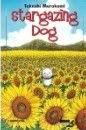 "WHEN ONE'S MESSED UP, EVEN THE STUPID FISH KNOW IT." From its very opening -- police find a junked out vehicle with two bodies, a long-dead male and a more recently deceased dog -- you know that Takashi Murakami's Stargazing Dog (NBM) is going to end on a melancholy note. And so this best-selling manga does, though writer/artist Murakami also manages to imbue his effectively sentimental dog tale with enough lightness to keep it from bludgeoning you. "WHEN ONE'S MESSED UP, EVEN THE STUPID FISH KNOW IT." From its very opening -- police find a junked out vehicle with two bodies, a long-dead male and a more recently deceased dog -- you know that Takashi Murakami's Stargazing Dog (NBM) is going to end on a melancholy note. And so this best-selling manga does, though writer/artist Murakami also manages to imbue his effectively sentimental dog tale with enough lightness to keep it from bludgeoning you.The story of Daddy, a somewhat dim patriarch who loses his job, home, and family -- but never the company of his loyal pup Happie -- Stargazing Dog tracks Daddy's misfortunes through the canine's naive eyes. To Happie, all that matters is the time he spends with his owner. When Daddy loses his job, for instance, the dog is overjoyed to have walks in the daytime; when the two travel south, living out of Daddy's car, all the dog sees is a “fun road trip.” Just being in Daddy's presence is sufficient. Everything else is just details. With its opening panels of dragonflies buzzing around the trashed car to its penultimate scene where a bedraggled Daddy and Happie look up at the night sky, Stargazing Dog has a visual sweetness that carries you through even its saddest moments. The key to it all proves the title character, of course, who views Daddy's downfall through a childlike/canine perspective. As Murakami notes in an “Afterword,” the tragic flaw of Happie's master proves his inability (or perhaps unwillingness) to adapt to the changing world around him. Yet, ironically, it's the constancy of his dog who provides his salvation. “I lost everything,” the human tells his companion at one point, “but as you are sitting next to me, I'm strangely happy.” The title story is followed in NBM's edition by a 50-page sequel, “Sunflowers,” about a social worker named Okutsu who is driven to learning the story behind the nameless vagrant and his dog. In so doing, he recalls his own life living with a pair of elderly ailing grandparents and the dog they'd given him for the day they passed away. In this piece, the meaning of the book's title is explained. “It's an expression for a person who hopes for too much,” Okutsu notes, adding that it's human nature for all of us to do so. In the end, the companionship of Daddy and his dog stands for something that is attainable in our lives -- even in an era when so many other dreams are being dashed. No wonder this book resonated so much in its native land. “I myself was also saved by my own dog,” Murakami writes in his “Afterword.” We don't doubt him at all. (First published on Blogcritics.) Labels: sixty-minute manga # |Tuesday, November 08, 2011 ( 11/08/2011 06:43:00 AM ) Bill S.  WHERE I’VE BEEN: Where I’ve been is in the nether zone between one mailing address and the next. Four years after our move from IL to AZ, it became increasingly apparent that the place we’d called home had gotten too expensive for us. When we first moved to Safford, AZ, the town was still in the midst of a mining boom (copper being the ore of choice) and housing was at a dear premium. One long recession and two job changes later (not to mention several major budget cuts to behavioral health services where I work), and we found ourselves looking for a cheaper place to rent. Found one two towns over in Pima, AZ, home to pima cotton, and so the past month has been spent boxing and storing and ultimately lugging all our goods to their new spaces. Once we moved, it took over a week to get our ISP transferred over to the new home – we definitely live out in the frontier. WHERE I’VE BEEN: Where I’ve been is in the nether zone between one mailing address and the next. Four years after our move from IL to AZ, it became increasingly apparent that the place we’d called home had gotten too expensive for us. When we first moved to Safford, AZ, the town was still in the midst of a mining boom (copper being the ore of choice) and housing was at a dear premium. One long recession and two job changes later (not to mention several major budget cuts to behavioral health services where I work), and we found ourselves looking for a cheaper place to rent. Found one two towns over in Pima, AZ, home to pima cotton, and so the past month has been spent boxing and storing and ultimately lugging all our goods to their new spaces. Once we moved, it took over a week to get our ISP transferred over to the new home – we definitely live out in the frontier.But we’re quasi-settled now (still a lotta stuff in boxes, of course), so hopefully I’ll be able to get some reviews and commentary up on this here blog. Got a pile of material that’s demanding to be attended to. Labels: me me me # | |
|
|