| Pop Culture Gadabout | ||
|
Friday, August 22, 2008 ( 8/22/2008 06:19:00 AM ) Bill S. 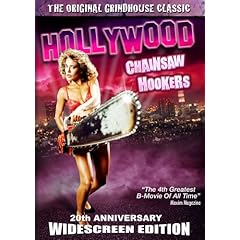 "BEING A DICK IS A TWENTY-FOUR-HOUR-A-DAY JOB." Look at a title like Hollywood Chainsaw Hookers and you pretty much know what you're gonna get: buxom starlets, severed limbs, a shoestring budget and plenty of intentional and/or unintentional camp. The creation of fecund exploitation moviemaker wrestler Fred Olen Ray, Hookers has recently been released in a snappy new 20th anniversary Retromedia DVD edition which advertizes it as "The Original Grindhouse Classic." Despite the Grindhouse appellation, this flick has no legit connection to the Tarantino/Rodriguez camp, though Fred does tack the same cheesy retro "Feature Presentation" opener before his flick that appeared with Death Proof and Planet Terror. Vaguely dishonest? Sure. Well in keeping with the dictates of z-movie hucksterism? Also, sure. "BEING A DICK IS A TWENTY-FOUR-HOUR-A-DAY JOB." Look at a title like Hollywood Chainsaw Hookers and you pretty much know what you're gonna get: buxom starlets, severed limbs, a shoestring budget and plenty of intentional and/or unintentional camp. The creation of fecund exploitation moviemaker wrestler Fred Olen Ray, Hookers has recently been released in a snappy new 20th anniversary Retromedia DVD edition which advertizes it as "The Original Grindhouse Classic." Despite the Grindhouse appellation, this flick has no legit connection to the Tarantino/Rodriguez camp, though Fred does tack the same cheesy retro "Feature Presentation" opener before his flick that appeared with Death Proof and Planet Terror. Vaguely dishonest? Sure. Well in keeping with the dictates of z-movie hucksterism? Also, sure.Ray's movie concerns an unshaven "private dick" named Jack Chandler (Jay Richardson) who is hired to find an Oxnard runaway named Samantha (scream queen Linnea Quigley) on the streets of L.A. Sam, it turns out, has hooked up with a chainsaw-wielding cult of streetwalkers led by burly Gunnar Hansen (the original Leatherface – much less creepy as an Anubis-worshipping high priest than he is squealing like a pig). Though our wisecracking narrator Chandler points out the movie's core absurdity – the fact that a self-described "ancient" cult would utilize modern chainsaws ("Who do you pray to? Black and Decker?") – the movie blithely refuses to cobble together even a flimsy defense of itself. Forget it, Jack, it's just Los Angeles. The whole nonsensical shmear ends in a seedy warehouse temple where we get to watch a drugged-out body-painted Quigley dance the Virgin (hah!) Dance of the Double Chainsaws, then duel the cult's high priestess with one of the saws. To those who recall Miz Q.'s memorable topless graveyard dance in Return of the Living Dead, the dance is a bit of a letdown, but, then, it's hard to move sensually when you've got a heavy power tool in both hands. Ray ends his flick leaving room for a sequel, but to the best of my knowledge he never followed up on this. Guess he said all he had to in the first 'un. Of course, the burning question in the minds of most would-be Hookers viewers is, "Do we get any nekkid gurls with 'saws in this flick?" Yup, we surely do. Ray obliges with two – count 'em! – two agreeably blood-drenched murder sequences as cult members first seduce than dismember a burly construction worker and a nerdy bow-tied perv. In one of the movie's cuter moments, the lunatic Mercedes (Michele Bauer, here billed as Michelle McLellan) covers an Elvis poster with plastic sheeting to protect it from the impending spatter as her handcuffed beau Bo (Jimmy Williams) cluelessly watches. The lady may worship Anubis, but Elvis is still the King. The new 20th anniversary DVD comes with a commentary track by Ray and his co-writer T.L. Lankford, a "making of" documentary that primarily consists of the director standing in front of a curtain and talking into the camera, plus an episode of "Nite Owl Theater," one of the pre-Morella-styled introductory sequences that Ray filmed with his wife Kimberly Ray for earlier Retromedia DVDs. In the documentary, Ray (who also has a series of soft-core sex comedies to his credit under the name of Nicholas Medina) reveals that the film was initially funded by an adult film company looking to go legit. Now that's funny . . . # | Wednesday, August 20, 2008 ( 8/20/2008 06:33:00 AM ) Bill S. MID-WEEK MUSIC VIDEO: Let's get into some Swedish Eurodisco with this cool Stéphane Manel animated video (love the Pong ref) for Pacific!'s "Hot Lips": # | Tuesday, August 19, 2008 ( 8/19/2008 06:48:00 PM ) Bill S.  "ALL THE FLAT-TOP CATS AND ALL THE DUNGAREE DOLLS" Let's start with this uncontroversial pronouncement: if you care anything at all about the power and splendor of early rock 'n' roll, you need to have some Little Richard in your collection. A true musical wild man, Richard Penniman opened up the music in ways that were essential for pop's evolution. In a world of blues shouters, Little Richard was the first great musical screamer. A lot of rock vocalists owe their shredded larynxes to the man. "ALL THE FLAT-TOP CATS AND ALL THE DUNGAREE DOLLS" Let's start with this uncontroversial pronouncement: if you care anything at all about the power and splendor of early rock 'n' roll, you need to have some Little Richard in your collection. A true musical wild man, Richard Penniman opened up the music in ways that were essential for pop's evolution. In a world of blues shouters, Little Richard was the first great musical screamer. A lot of rock vocalists owe their shredded larynxes to the man.Very Best of Little Richard is the latest in a line of best-of collections capturing this divine mad man at his peak: the years 1955-6 when he was recording for the Specialty label. As venerable r-&-r liner note writer Billy Vera reminds us, Richard resigned from the music biz in '56 to take up the ministry after a burning airplane propeller made him very aware of his own mortality. Though the singer and pianoman would repeatedly return to playing the "devil's music" in later years, nothing quite matched the sheer lascivious power of the early Specialty cuts. As backed by the Upsetters (most memorably, saxman Lee Allen), this was the sound of horniness at its most unrestrained - even the bastardized attempts to refocus the youth of America toward Pat Boone's milk-safe covers couldn't tamp down the lusty truths that Little Richard was shrieking. Take the man's first hit single, "Tutti Frutti." Even with the song's original ribald lyrics rewritten (depending on who you read, the song's original signature chorus was either "Tutti Frutti, good booty" or "loose booty" - and not "oh, Rudy"), there's no escaping the singer's intent. The singer's trilling whoops tell the story better than any words can. Or consider our man's version of Bobby Troup's "The Girl Can't Help It," perhaps the greatest tribute to bimbodom ever sung. If you've ever seen the grandly stoopid Frank Tashlin comedy for which it was recorded, it's impossible to hear this track without visualizing a pneumatic Jayne Mansfield strolling down the city sidewalks. Prior to this newest CD release, the best Little Richard collection was arguably Rhino's 18 Greatest Hits, which also focused on the Specialty years. This new collection adds seven tracks of variable interest. None of 'em truly fall under the title Very Best, but when you've already run your listener through the original "Long Tall Sally," "Good Golly, Miss Molly, "Slippin' And Slidin'" and "Rip It Up," the final tracks almost serve as a cool down. Two marginally successful attempts at reviving Tin Pan Alley hits ("Baby Face" and "By the Light of the Silvery Moon") with a New Orleans beat much as Fats Domino did with "My Blue Heaven" mainly serve as object lessons in just how different the two singers were. Domino's tracks are more genial and slyly lecherous; Richard's strengths lay in shouting out his intentions. Additionally, the new disc includes one of two blues tracks that Richard assayed for a demo tape. For hardcore Penniman fans, this is akin to Elvis Presley's early tape of "My Happiness": more interesting as historical artifact than as a fully realized piece of music. That someone (in this case, Specialty Records owner Art Rupe) was able to hear the manic potential buried deep within "Baby" is definitely Good Rudy. # | |
|
|